
Posted by
Blog
Glass vs Cloth Mousepad: What’s the Difference and Which One Should You Choose?

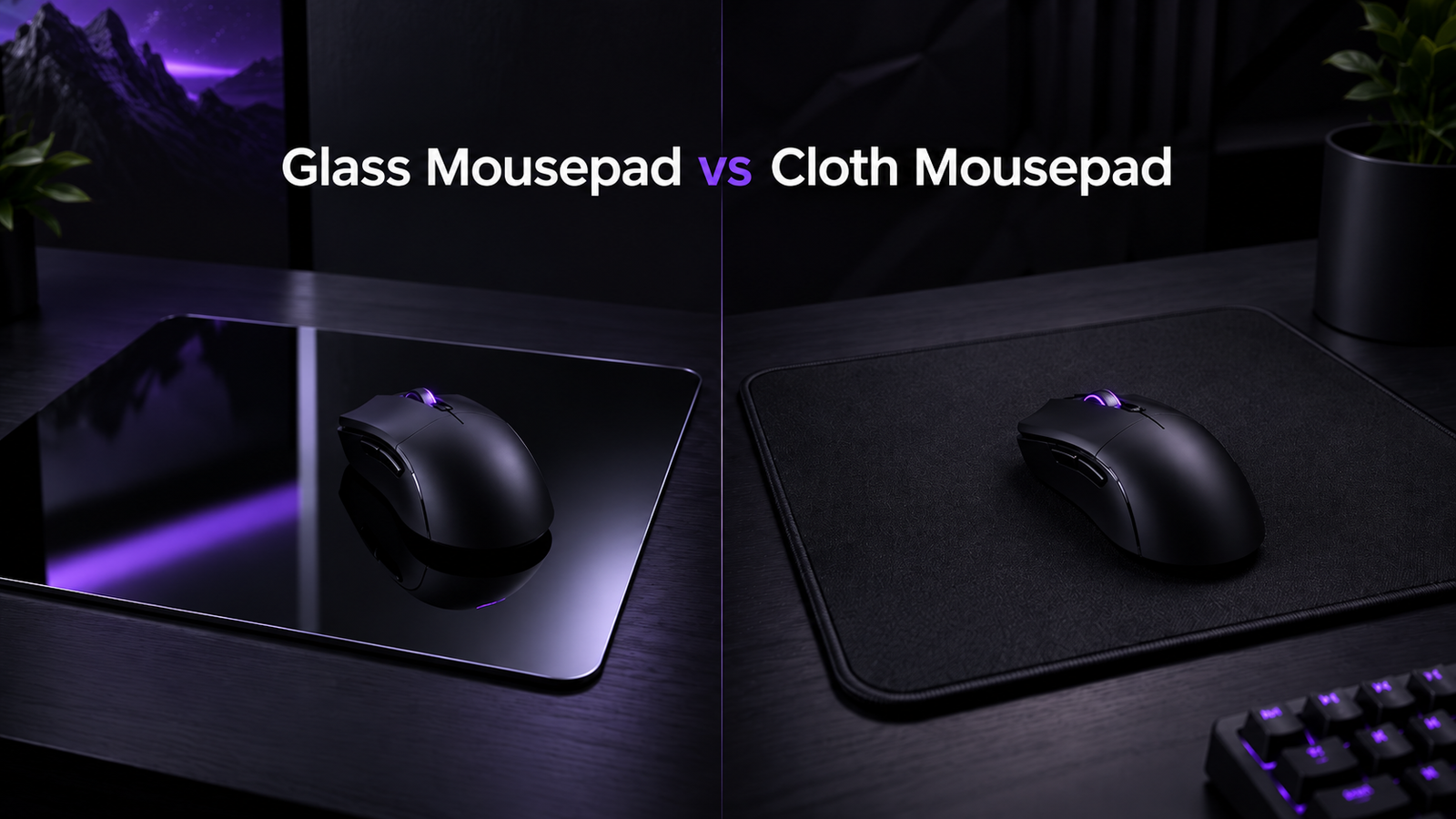
Glass mousepad vs cloth mousepad is a comparison that comes down to speed, control, consistency and personal preference.
Your mousepad can have a bigger impact on your aim than you might expect.
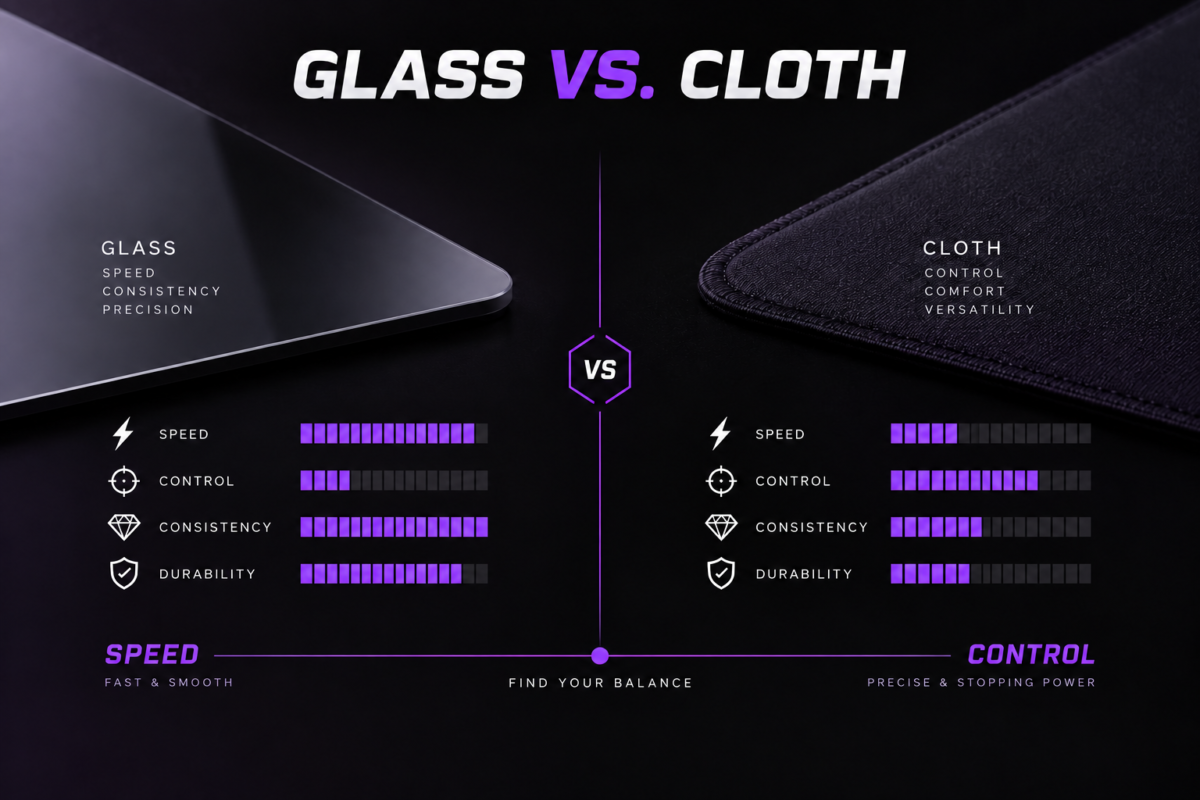
While both glass and cloth mousepads are designed to provide a consistent surface for your mouse, the way they feel in-game can be completely different. Glass mousepads are known for their extremely smooth glide, low friction and consistent surface, while cloth mousepads generally offer more resistance, stopping power and comfort.
Neither option is automatically better. The right choice depends on your sensitivity, aim style, the games you play and, most importantly, how much speed or control you want from your mouse.
In this guide, we’ll compare glass and cloth mousepads across speed, control, consistency, durability, comfort, mouse skate wear and maintenance so you can decide which surface makes the most sense for your setup.
Bottom line:
Glass mousepads prioritise speed and consistency. Cloth mousepads generally provide more control, comfort and a wider range of surface options.
Glass mousepads prioritise speed and consistency. Cloth mousepads generally provide more control, comfort and a wider range of surface options.
Glass vs Cloth Mousepad: Quick Comparison
Good to know:
Cloth does not automatically mean slow. Cloth mousepads range from heavily controlled surfaces to fast pads with very little resistance.
Cloth does not automatically mean slow. Cloth mousepads range from heavily controlled surfaces to fast pads with very little resistance.
What Is a Glass Mousepad?
A glass mousepad uses a rigid glass surface instead of the woven fabric found on traditional gaming mousepads.
Its main characteristic is low friction. The mouse requires very little force to begin moving, which creates a fast, smooth and almost effortless glide.
Because the surface itself does not compress like fabric, glass pads also provide a very consistent feeling across the entire mousepad. They are far less affected by factors such as humidity and are easy to wipe clean when dust or dirt builds up.
This makes glass particularly appealing to players looking for a fast surface that maintains a similar glide over time.
Products such as the Yuki Aim x Pulsar Superglide3 Glass Mousepad are examples of the type of modern glass surface designed around speed, smooth movement and consistency.
ㅤ

ㅤ
What Is a Cloth Mousepad?
Cloth remains the most common mousepad material, but there is much more variation between cloth surfaces than the name might suggest.
Different weaves, textures, thicknesses and materials can dramatically change how a mouse feels.
Some cloth pads are designed around maximum control and create noticeable resistance when moving the mouse. Others aim for a balanced feeling between speed and stopping power, while speed-oriented cloth pads can feel surprisingly fast.
That variety is one of the biggest advantages of cloth.
Rather than having one characteristic feel, cloth mousepads cover a very wide spectrum:
CONTROL ←──────────── BALANCED ────────────→ SPEED
This makes it easier to find a surface that closely matches your preferred sensitivity and aim style.
For example, the X-raypad Aqua Control Zero focuses on a balance between control and speed, while the Aqua Control II offers a faster hybrid cloth surface.
ㅤ
Glass vs Cloth Mousepad: What Are the Main Differences?
Speed and Glide
This is probably the most noticeable difference when moving from cloth to glass.
Glass mousepads usually have significantly lower friction. Small mouse movements require very little effort, while longer swipes feel smooth and uninterrupted.
That can make fast tracking and repeated micro-adjustments feel extremely responsive.
Cloth introduces more resistance between the mouse skates and the surface. How much resistance you feel depends heavily on the individual mousepad, but the movement will generally feel less effortless than on glass.
For players moving from a traditional control pad, a glass mousepad can initially feel very fast.
Tip:
Don’t judge a glass mousepad after only a few minutes. The reduction in friction can require some adjustment if you’ve spent years playing on cloth.
Don’t judge a glass mousepad after only a few minutes. The reduction in friction can require some adjustment if you’ve spent years playing on cloth.
Control and Stopping Power
Speed is only one part of aiming. You also need to stop the mouse where you want it.
This is where stopping power becomes important.
Cloth surfaces generally create more friction when slowing down a movement, which can give the player a stronger feeling of control when stopping after a flick or making small corrections.
Glass provides less resistance, so stopping the mouse depends more heavily on the player’s hand and arm control.
That does not mean glass lacks precision. Rather, it changes where that control comes from.
On cloth, the surface itself helps resist movement. On glass, the player gets much less assistance from surface friction.
ㅤ
Tracking vs Flicking
Your aim style can also influence which surface feels more natural.
Tracking involves continuously following a moving target. The low friction of glass can make these movements feel particularly smooth because the mouse can change direction without fighting against the surface.
Flicking involves rapidly moving towards a target and stopping accurately. Here, some players prefer the additional stopping power provided by cloth.
This is one reason why two players using the same sensitivity and playing the same game can still prefer completely different mousepads.
Good to know:
The game you play does not determine the mousepad you need. Your sensitivity, aiming technique and personal preference can matter just as much.
The game you play does not determine the mousepad you need. Your sensitivity, aiming technique and personal preference can matter just as much.
Surface Consistency
One of the strongest advantages of glass is consistency.
Glass does not absorb moisture in the same way as fabric, and the surface itself changes very little through normal use.
Cloth can be more sensitive to environmental conditions.
Humidity, sweat, skin oils and accumulated dirt can gradually change how parts of a cloth mousepad feel. With extended use, some pads can also develop slower areas where the surface receives the most movement.
A quality cloth mousepad can still remain consistent for a long time when properly maintained, but glass generally requires less effort to preserve its original surface characteristics.
ㅤ
Durability
Glass mousepads have an obvious advantage when it comes to surface wear.
A glass surface does not gradually lose its weave or texture like cloth does, making it capable of maintaining a similar glide for a very long time.
However, glass introduces a different consideration: impact.
While designed for normal desktop use, a glass mousepad is a rigid product and needs to be handled differently from a cloth pad.
Cloth pads gradually wear rather than being vulnerable in the same way to hard impacts, and they are also much easier to roll up, store or transport.
Bottom line:
Glass offers excellent long-term surface durability, while cloth is easier to transport and replace.
Glass offers excellent long-term surface durability, while cloth is easier to transport and replace.
Mouse Skate Wear
This is an important factor that should not be ignored when considering a glass mousepad.
A hard glass surface can wear down mouse skates faster than cloth.
PTFE skates are designed to reduce friction between your mouse and mousepad, but constant contact with a rigid surface can gradually wear them down.
How quickly this happens depends on the surface, your mouse, your skates and how much you play.
Using glass therefore means it is worth checking your mouse skates periodically and replacing them when necessary.
On cloth, skate wear is generally much slower.
If you use a glass mousepad regularly, checking your skates becomes part of normal maintenance. Options such as X-Raypad Obsidian Universal Dots are designed for use on both cloth and glass surfaces.
ㅤ
Comfort
Comfort is another major difference.
A cloth mousepad has some degree of cushioning, particularly when it uses a soft foam or rubber base. This can make resting your wrist or forearm on the pad more comfortable during long sessions.
Glass is completely rigid.
Some players enjoy that solid feeling, while others find a hard surface less comfortable against their skin.
Glass can also feel noticeably colder, particularly when you first place your arm on it.
For long gaming or work sessions, this difference may matter just as much as performance.
ㅤ
Noise
Glass is generally louder.
Mouse skates moving across a hard surface produce more audible feedback than they do on fabric.
Cloth absorbs more of that contact and is usually much quieter.
This probably will not influence everyone’s buying decision, but it can matter if you prefer a quiet setup, play late at night or keep your microphone close to the mousepad.
ㅤ
Cleaning and Maintenance
Glass is extremely easy to maintain.
Dust and fingerprints can usually be removed quickly with a suitable cloth, and the surface does not absorb sweat or liquids like fabric.
There is one catch: because glass is so smooth, even a small particle of dust between the mouse skate and the pad can become noticeable.
Keeping both the surface and your mouse skates clean is therefore important.
Cloth mousepads hide small particles more easily but gradually absorb sweat, dust and skin oils. They typically need a more thorough cleaning from time to time to restore the surface.
Tip:
Keeping both your mousepad and mouse skates clean helps preserve consistent glide regardless of which surface you use.
Keeping both your mousepad and mouse skates clean helps preserve consistent glide regardless of which surface you use.
Glass vs Cloth Mousepad for FPS Games
For competitive FPS players, the choice usually comes down to the relationship between speed and control.
Glass can be particularly appealing if you want extremely low friction, make frequent micro-adjustments or use large movements with a low sensitivity.
The effortless glide can also work well for tracking-heavy aim styles where you need to continuously follow a moving opponent.
A control-oriented cloth mousepad creates more resistance and may feel more predictable for players who rely heavily on flicks and sharp stops.
Games such as VALORANT or Counter-Strike 2 do not automatically require a control pad, just as Apex Legends or Overwatch 2 do not require glass.
There are players using both surfaces successfully across all of these games.
Your aim style matters more than the genre label.
ㅤ
What About Non-Competitive Gaming?
For single-player games, MMOs, MOBAs and more casual gaming, the performance differences between glass and cloth become less critical.
Comfort, available desk space and personal preference may matter more.
If your setup is used for both gaming and everyday productivity, you may also prefer the softer feeling of cloth under your arm.
On the other hand, players who simply enjoy an extremely smooth mouse movement can still appreciate glass even when competitive performance is not the priority.
ㅤ
Which Mousepad Should You Choose?
There is no universal winner.
A glass mousepad makes the most sense if you value maximum speed, minimal friction, an extremely consistent glide and easy maintenance.
A cloth mousepad may suit you better if you want more stopping power, a softer surface, lower mouse skate wear or the ability to choose between a much wider range of speed and control characteristics.
For players already comfortable with traditional gaming mousepads, cloth will usually feel more familiar.
Glass provides a more distinctive experience and is worth considering if you feel that your current surface creates more resistance than you want.
If you prefer a more traditional cloth feel with smooth glide and steady control, the Zowie G-SR-SE is another option worth considering.
Which Surface Fits Your Aim Style?
Frequently Asked Questions
Is a glass mousepad better than a cloth mousepad?
Not necessarily. Glass provides lower friction, higher speed and excellent consistency, while cloth generally provides more stopping power, comfort and surface variety. The better option depends on your preferences and aim style.
Are glass mousepads good for FPS games?
Yes. Their fast and consistent glide can work particularly well for players who enjoy low friction, tracking and frequent micro-adjustments. However, many competitive FPS players still prefer cloth because of its additional stopping power.
Are glass mousepads too fast?
They can feel too fast for players accustomed to control-oriented cloth mousepads. There is usually an adjustment period when moving from a high-friction surface to glass.
Do glass mousepads wear out mouse skates faster?
Generally, yes. A hard glass surface tends to cause more mouse skate wear than cloth, so skates may need to be replaced more frequently.
Are cloth mousepads better for control?
Control-oriented cloth surfaces generally provide more friction and stopping power than glass. However, cloth mousepads vary significantly, and some are designed specifically for speed.
Are glass mousepads affected by humidity?
Glass is considerably less affected by humidity than cloth because it does not absorb moisture in the same way.
Are glass mousepads easy to clean?
Yes. Easy maintenance is one of their main advantages. Dust, fingerprints and other surface dirt can usually be removed quickly.
Can you use any gaming mouse on a glass mousepad?
Most modern gaming mice can be used on glass mousepads, although sensor behaviour, mouse skates and the specific glass surface can influence the experience.
ㅤ
Glass or Cloth: The Bottom Line
Choosing between glass and cloth is ultimately about how you want your mouse to move.
Glass prioritises speed, low friction and long-term consistency. Cloth gives you more control over how much friction you want and provides a softer, more traditional feel.
Neither surface will automatically improve your aim. But choosing one that matches your movement style can make your setup feel considerably more natural.
If your current mousepad feels too slow and you want your mouse to move with as little resistance as possible, glass is worth exploring.
If you prefer stronger stopping power or simply want more choice between control, balance and speed, cloth remains an excellent option.
ㅤ
Find the right surface for your setup.
From ultra-fast glass surfaces to controlled cloth mousepads, find the pad that matches the way you play.

Related Posts
Glass vs Cloth Mousepad: What’s the Difference and Which One Should You Choose?
Posted by
Glass mousepad vs cloth mousepad is a comparison that comes down to speed, control, consistency and personal preference. Your mousepad can have a bigger impact on your aim than you…
CONTINUE READING